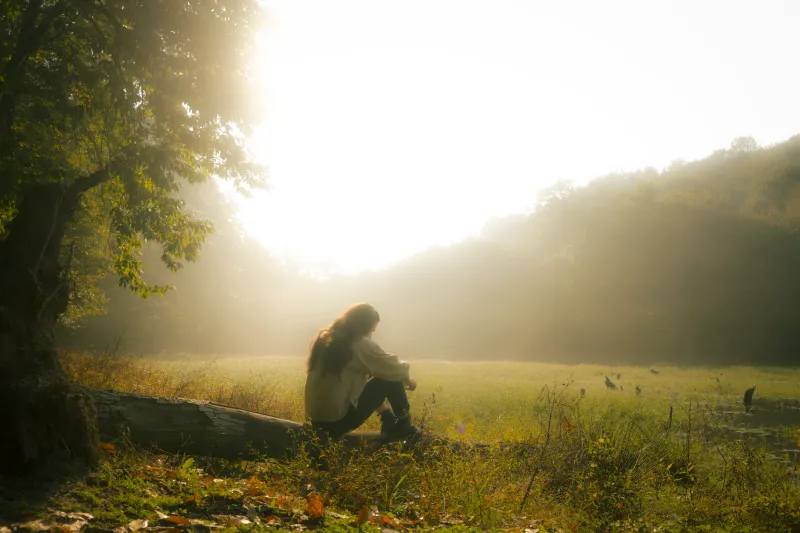
What If the Waiting Isn't the Worst Part? Learning to Live Inside the In-Between

You're Not Stuck. You're Suspended.
There's a particular kind of misery that comes not from pain itself, but from the conviction that the pain shouldn't be happening. You're in the middle of something — a career shift, a relationship ending, a version of yourself you've outgrown but haven't fully shed — and instead of just being in it, you're furious that you're still there.
That fury is exhausting. And honestly? It's doing more damage than the transition itself.
Here's what most of us were never told: the in-between isn't a waiting room. It's not a malfunction. It's not the universe failing to deliver on a promise. The uncomfortable stretch between who you were and who you're becoming is the actual work. And the sooner we stop treating it like something to escape, the sooner it starts to make sense.
Why We Resist So Hard
American culture doesn't have a lot of patience for process. We celebrate the breakthrough, the glow-up, the before-and-after. We love a good transformation story — but only once it's finished. The messy middle doesn't make for great content, and it definitely doesn't feel good to live in.
So when we find ourselves suspended in uncertainty, our instinct is to treat it like a problem. We hustle harder, we overanalyze, we make impulsive decisions just to feel like we're doing something. Anything to get out of the discomfort faster.
Psychologically, this makes complete sense. Our brains are wired to flag ambiguity as a threat. When you don't know what comes next, your nervous system treats that unknown the same way it would treat actual danger. The discomfort of not-yet-knowing triggers the same stress response as something genuinely threatening — which is why transitions can feel so disproportionately hard even when, objectively, you're okay.
But here's the thing about fighting that discomfort: resistance doesn't shorten the in-between. It just makes it louder.
The Chrysalis Doesn't Apologize for Taking Time
A butterfly doesn't form inside the chrysalis by powering through. The process is actually pretty wild — the caterpillar essentially dissolves, breaking down into something close to biological soup before it reorganizes into something entirely new. There's no shortcut. There's no hack. The transformation requires the full duration of the in-between.
And crucially, the chrysalis isn't a punishment. It's not a consequence of doing something wrong. It's not a sign that the caterpillar failed at being a caterpillar. It's just what's necessary.
Your own in-between seasons work the same way. The confusion, the not-knowing, the sense of being neither here nor there — that's not evidence that something has gone sideways. It's evidence that something real is happening.
Acceptance Isn't the Same as Giving Up
This is where a lot of people get tripped up. When someone suggests accepting the uncomfortable middle, it can sound like settling — like being told to just be fine with something that doesn't feel fine. But acceptance, in the truest sense, isn't passive. It's not resignation.
Acceptance is the act of stopping the war with reality. It's saying: this is where I am right now, and fighting that fact isn't going to change it. It's the difference between swimming against a current until you're depleted and learning to float while you figure out which direction to swim.
Acceptance doesn't mean you have to enjoy the discomfort. It doesn't mean you stop wanting things to change. It just means you stop spending your energy on the part you can't control — the that it's happening — and redirect it toward the part you can — how you're moving through it.
That shift alone can take an enormous amount of pressure off.
What the Discomfort Might Actually Be Teaching You
When we stop trying to outrun the in-between, something interesting happens: we start noticing what's inside it.
Discomfort has information. The restlessness you feel during a career transition might be pointing you toward what you actually want, not just what you thought you wanted. The grief that surfaces when a relationship ends isn't just about loss — it's also about values, about what mattered to you, about who you are when you're not performing for someone else.
The awkwardness of being mid-transformation — not fully the old version of yourself, not yet the new one — can surface some surprisingly honest material. What do you actually believe? What do you need that you've never let yourself ask for? What parts of your old identity were never really yours to begin with?
You can't access any of that when you're in full-sprint escape mode. It only becomes available when you slow down enough to be present in the discomfort instead of running from it.
A Few Things That Actually Help
None of this means you have to suffer in silence or pretend everything is fine. Here are some genuinely useful ways to be with the in-between rather than against it:
Name where you are. Literally say it out loud or write it down: I'm in a transition. I don't know what comes next. That's uncomfortable, and it's also okay. Naming your experience reduces the brain's threat response. It sounds simple because it is — and it works.
Shrink your time horizon. You don't have to figure out the next five years. You just have to figure out today, or even just this week. Big-picture uncertainty feels unbearable when you're already dysregulated. Smaller windows are more manageable.
Find anchors, not distractions. There's a difference between numbing out to avoid the discomfort and doing something grounding that helps you stay present through it. A walk outside, a real conversation with someone you trust, a creative outlet — these aren't escapes. They're anchors that help you stay steady while the transformation does its work.
Stop measuring progress by how it feels. Transformation rarely feels good in the middle. Feeling uncertain, raw, or unsettled doesn't mean you're doing it wrong. It often means you're right on track.
Trust Your Own Unfolding
You have made it through every difficult season of your life so far. Every time you thought you couldn't tolerate the uncertainty a day longer, you did. That's not nothing — that's a track record.
The in-between you're in right now is not the end of the story. It's not even the worst part. It's the part where the real rearranging happens, quietly and without fanfare, underneath everything you can see.
You don't have to love it. You don't have to feel grateful for it every day. But you can stop treating it like something that's happening to you and start recognizing it as something happening for you — even when it doesn't feel that way yet.
The chrysalis doesn't apologize for being uncomfortable. It just keeps doing what it came here to do. Maybe that's the permission you needed to do the same.