Something in You Already Knows It's Time: How to Read the Signs That Your Season of Stillness Is Ending
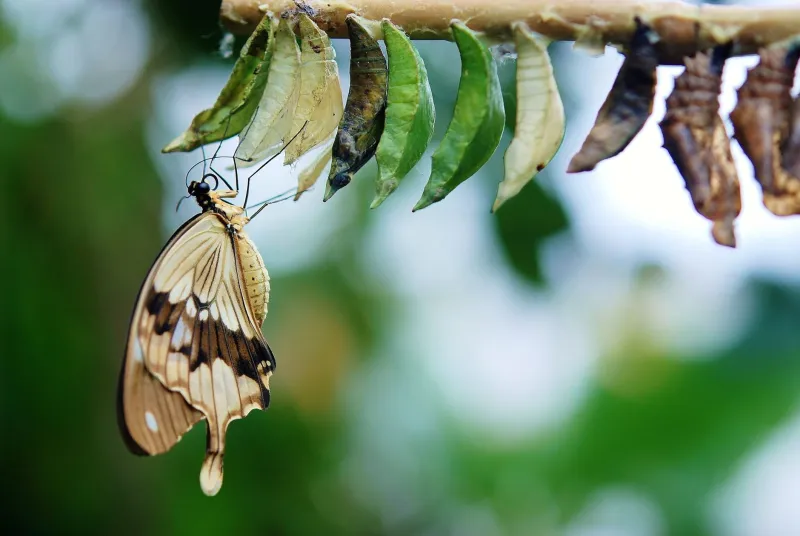
Pulling back from the world is one thing. Knowing when to return is another thing entirely.
Most of us can feel the pull inward — the need to slow down, step away, and do the invisible work that big life changes demand. We get good at going quiet. We learn to protect our energy, create space, and let ourselves be unfinished for a while. That's real, legitimate growth.
But here's the part nobody really prepares you for: figuring out when that season is actually over.
Because here's the truth — the cocoon doesn't announce its completion. There's no alarm, no certificate, no moment where the sky opens up and a voice tells you you're ready. Instead, there are whispers. Subtle shifts. Small, easy-to-overlook signals that something inside you has settled into a new shape and is quietly, persistently leaning toward the door.
Learning to hear those signals — and trust them — is its own kind of courage.
The Restlessness That Feels Different This Time
There's a restlessness that belongs to the cocoon. It's the anxious, unsettled kind — the pacing, the questioning, the what is even happening to me feeling. That kind of restlessness is part of the process. It means you're in it.
But there's another kind of restlessness that shows up later, and it feels different in your body. It's less frantic. More like a pull. Like standing at a window and genuinely wanting to be outside, rather than just fearing what might happen if you stayed in.
If you've been in a season of withdrawal — whether that looked like therapy, a major life pause, grief, burnout recovery, or just a long stretch of turning inward — pay attention to the quality of your restlessness. When it starts to feel more like readiness than unease, that's worth noticing.
You're not falling apart again. You might actually be itching to move.
Your Curiosity Comes Back Before Your Confidence Does
One of the earliest signs that a withdrawal season is wrapping up isn't that you feel ready — it's that you feel curious again.
You start wondering about things outside yourself. You find yourself genuinely interested in what a friend is working on, or you catch yourself thinking about a project you'd shelved, or something in the news actually makes you want to engage rather than hide. Small sparks of outward attention start lighting up.
This matters because curiosity is a forward-facing emotion. It's your nervous system signaling that it's safe enough to look beyond the immediate. Confidence tends to come later — after you've taken a few steps and survived them. But curiosity? That arrives first, like a scout sent ahead of the group.
If you've been mostly numb or inward for a while and you notice genuine interest in the world flickering back to life, don't dismiss it as distraction. It might be direction.
The Weight of Your Story Starts to Lighten
When we're deep in transformation, we tend to carry our story heavily. The thing that happened, the version of ourselves we're leaving behind, the grief of it — it sits on our chest. We need to talk about it, process it, return to it again and again.
That's appropriate. That's what healing asks of us.
But there often comes a point where you notice you can tell your story without being swallowed by it. You can describe what you went through without your voice cracking every time. You can hold what happened with something closer to perspective — not bypassing the pain, but not being flattened by it either.
That shift — from being inside the story to being able to hold the story — is a meaningful one. It suggests that the emotional processing has moved through a significant threshold. You haven't forgotten. You haven't minimized. But you've integrated enough that the past is starting to feel like context rather than crisis.
You Start Wanting to Give, Not Just Receive
Transformation seasons are, by necessity, self-focused. You have to be. You're doing the internal work, tending to your own wounds, figuring out who you're becoming. There's not a lot of bandwidth left for pouring into others, and that's okay. That's appropriate.
But watch for the moment when you start feeling the genuine urge to contribute again. To show up for someone else. To share what you've learned, or just to be present for a friend who's struggling. That outward pull — the desire to give rather than just receive — often signals that your own cup has refilled to a point where there's something to offer.
This doesn't mean you're fully healed or that your needs are gone. It just means you've crossed a threshold where connection starts to feel nourishing again rather than draining.
Fear Is Still There — But It's Not the Loudest Voice Anymore
Here's something worth saying clearly: you will probably still be afraid when it's time to re-emerge. Fear doesn't disappear just because you're ready. If you're waiting for the fear to go away before you take a step, you might be waiting forever.
The real signal isn't the absence of fear. It's that fear has stopped being the most dominant voice in the room.
When you're not ready, fear is the whole conversation. It drowns everything else out. But when readiness is building, other voices start speaking up alongside it — curiosity, longing, hope, even a little excitement. They don't overpower the fear necessarily, but they share space with it. And in that shared space, you start to have a choice about which voice you follow.
That's the opening. That's the crack in the shell where the light gets in.
Trusting the Signal Even When the Timing Feels Imperfect
Here's the hard part: your emergence might not arrive at a convenient time. The world outside won't have paused and tidied itself up while you were doing your inner work. Life will still be complicated. Your circumstances might still be messy. The people around you won't necessarily understand what you've been through or how much you've changed.
And yet — the signal is the signal.
When your body, your emotions, and your gut are all quietly pointing toward it's time, the most courageous thing you can do is trust that. Not leap recklessly, not abandon all the care you've cultivated. But take one small, deliberate step outward and see what happens.
The butterfly doesn't wait for perfect weather. It waits until it's ready, and then it goes.
You've done the work. You've held the stillness. You've let yourself be remade in ways you probably can't fully articulate yet.
Something in you already knows.
Maybe it's time to listen.