Still Inside the Shell: What to Do When Your Growth Has Completely Stopped Moving

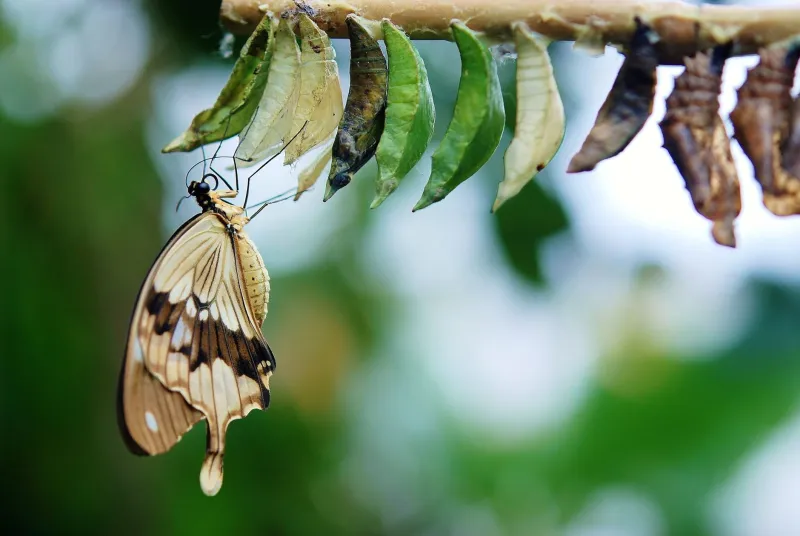
Everybody talks about the chrysalis like it's a beautiful, temporary thing. You go in, something mysterious happens, you come out changed. Clean narrative. Inspiring poster material.
But nobody really talks about what it feels like when you've been in there for a long time — longer than feels right — and nothing seems to be happening. No softening of the walls. No sense of anything shifting. Just you, in the dark, wondering if the whole process quietly gave up on you.
That feeling is real, and it deserves more than a pep talk.
First, Let's Be Honest About What This Feels Like
Genuine stagnation doesn't always look dramatic. It's not necessarily a breakdown or a crisis. Sometimes it just looks like... Tuesday. And Wednesday. And the same Tuesday and Wednesday for six months.
You might notice that the things you used to find meaningful feel hollow. That you're going through the motions of a life that used to fit but now feels slightly off, like clothes you've grown out of but haven't gotten around to replacing. There's a low-grade restlessness underneath everything, but it doesn't point anywhere useful. It just hums.
You might have tried things — journaling, therapy, a new routine, a conversation you'd been putting off — and felt nothing shift. That's the part that starts to mess with your head. Because you know what growth is supposed to feel like, at least a little. And this isn't it.
The Difference Between Resting and Being Stuck
This is where it gets genuinely tricky, because dormancy and stagnation can look almost identical from the inside.
Restful dormancy has a certain quality of okayness to it, even when it's uncomfortable. There's something underneath the quiet that feels like waiting rather than stopping. You might feel tired, but not hollow. You might be moving slowly, but there's still a faint sense of direction somewhere in the background.
Real stagnation feels different. It has a flatness to it. A kind of emotional monotone. You're not really waiting for anything, because it's hard to imagine what you'd even be waiting for. The future feels less like an open door and more like a wall painted to look like a door.
If you're reading this and something in you is nodding — not at the beautiful dormancy metaphor, but at the wall — that's worth paying attention to.
What Actually Causes Genuine Stagnation
A few things tend to create this kind of freeze, and they're worth naming honestly.
Unprocessed fear. Sometimes growth stops because we've arrived at the edge of something that actually scares us. Not in a thrilling, butterflies-in-your-stomach way — in a deep, quiet, I-don't-know-who-I-am-on-the-other-side-of-this way. The chrysalis holds because part of you isn't sure it's safe to leave.
Exhaustion that hasn't been acknowledged. American culture has a complicated relationship with rest. We tend to reframe burnout as a productivity problem rather than a signal that something fundamental needs to change. If you've been pushing through for a long time without real recovery, your system may have simply hit a wall.
A missing piece you haven't identified yet. Sometimes stagnation is your psyche's way of saying not yet — not because you're not ready, but because something you need (information, healing, a decision, a conversation) hasn't arrived yet. The pause is purposeful, but it doesn't feel that way because you can't see what's missing.
Grief you haven't fully sat with. Transformation always involves loss. Letting go of who you were, of relationships that don't fit the new version of you, of the life you thought you'd have. If that grief hasn't been honored, it has a way of quietly putting the brakes on everything else.
Gentle Ways to Test the Walls
The goal here isn't to force emergence. Pushing too hard against the walls of a chrysalis before it's time doesn't speed things up — it damages what's forming. But there's a difference between forcing and gently testing, and that distinction matters.
Try the smallest possible version of a new thing. Not a life overhaul. Not a dramatic gesture. Just the tiniest, lowest-stakes version of something that feels even slightly different from your current pattern. A different route to work. A conversation with someone you've been meaning to reach out to. A single hour doing something you used to love. You're not looking for transformation. You're just looking for a flicker.
Get honest with yourself about what you've been avoiding. Stagnation often has a specific address. There's usually something — a decision, a conversation, an acknowledgment — that you've been circling without landing. It doesn't have to be a big dramatic thing. Sometimes it's just admitting, quietly and privately, that something isn't working. Start there.
Talk to someone who's actually equipped to help. This isn't about venting to a friend over coffee, though that has its place. If you've been stuck for a while, a therapist or counselor can help you identify what's actually going on beneath the surface. There's no shame in needing a guide inside the dark. That's what guides are for.
Stop measuring yourself against your old timeline. One of the things that makes stagnation feel worse is the weight of expectations — what you thought would have happened by now, where you assumed you'd be. Those timelines were always made up. Letting go of them doesn't mean giving up. It means making room for what's actually unfolding instead of grieving the version that never existed.
Acknowledge where you are without making it mean everything. Being stuck right now doesn't mean you'll always be stuck. It doesn't mean you're broken or that growth has passed you by. It means you're in a hard part of a real process, and hard parts don't last forever, even when they feel like they will.
The Chrysalis Didn't Forget You
Here's the thing about transformation — it's not actually a linear, scheduled event. It's a biological process in the metaphorical sense, meaning it has its own intelligence and timing, and that timing doesn't always match what we had planned.
Being inside a stalled season doesn't mean the process is broken. It might mean you're closer to the edge than you think, and the last stretch is always the hardest. It might mean there's something still doing its quiet work that you can't see yet. It might mean you need something you haven't given yourself permission to ask for.
You haven't been abandoned inside this. The path hasn't disappeared. Sometimes the most important thing you can do is stop trying to prove that nothing is happening, and just let yourself be here — honestly, without performance — while you figure out what your next small move actually is.
The shell didn't break. But that doesn't mean it won't.