You Can Change Your Life Without Leaving It: The Truth About Transformation in Place

There's a story we keep telling ourselves about what real change is supposed to look like.
It usually involves a solo road trip. Or a month at a monastery. Maybe a dramatic resignation letter, a one-way ticket somewhere with a coastline, or at the very least, a long, uninterrupted stretch of silence where you finally — finally — figure yourself out.
And look, none of those things are bad. Sometimes a real departure is exactly what someone needs. But for most of us, most of the time, that kind of exit isn't available. There are kids to pick up from school. Rent that doesn't pause for personal growth. A partner, a parent, a job, a dog who needs feeding at 6 a.m. regardless of where you are emotionally.
So we wait. We tell ourselves the transformation will start when life slows down, when the kids are older, when we finally have the bandwidth. And meanwhile, the version of ourselves we're hoping to become stays parked in the driveway, waiting for a departure that never quite comes.
Here's what we don't talk about enough: you don't have to leave to change.
The Chrysalis Isn't Actually Empty
The butterfly metaphor is everywhere — and honestly, we love it here for a reason. But there's a part of the story that tends to get lost in translation.
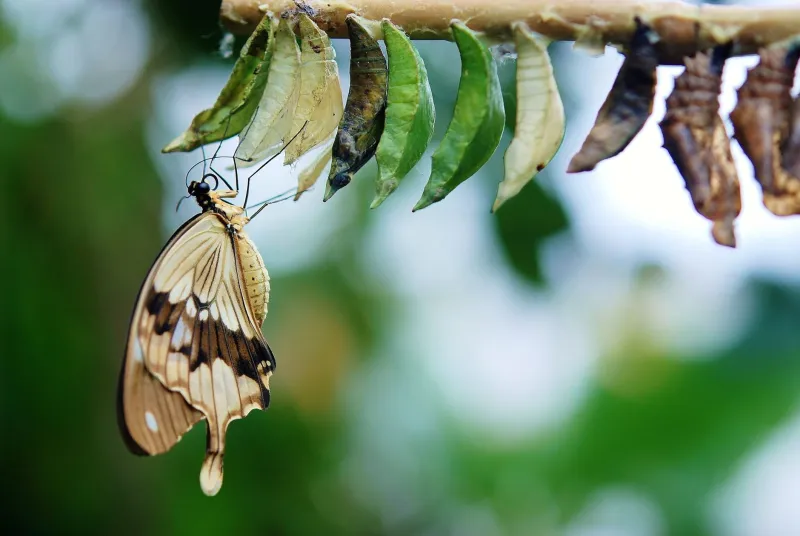
When a caterpillar forms a chrysalis, it doesn't leave its life behind. The chrysalis is the life. The transformation doesn't happen somewhere else; it happens inside the container that already exists. Yes, there's a period of going inward. Yes, things get messy and unrecognizable in there. But the whole process is happening within a structure that's still connected to a branch, still subject to weather, still very much part of the world.
Real transformation is a lot like that. It tends to happen inside the structure of your actual life — not outside of it.
The Myth That Keeps People Stuck
The idea that you need total isolation to grow isn't just inaccurate — it's actively harmful for a lot of people. It turns personal change into a luxury item, something available only to those with the time, money, and freedom to step away from their responsibilities.
It also quietly implies that your relationships, your routines, and your daily commitments are obstacles to growth rather than the very terrain where growth happens.
That's backwards.
Your coworker who constantly triggers you? That's a curriculum. Your teenager who won't talk to you? That's an invitation to practice patience you didn't know you needed. The morning you wake up exhausted and still show up anyway? That's not a detour around your transformation — that is your transformation.
Growth doesn't need a clean room. It needs honest attention.
What Integration Actually Looks Like
Transforming in place isn't the same as staying exactly where you are and hoping things shift on their own. It's active. It's intentional. It just doesn't require a plane ticket.
Here are some of the ways people actually do this:
They change their inner posture, not their outer location. A woman in suburban Ohio who felt completely stuck in her life didn't quit her job or move across the country. She started asking herself one question every morning: What would the person I'm becoming do today? Not a dramatic overhaul — just a small, consistent reorientation. Over time, her decisions shifted. Her relationships shifted. She shifted. Same zip code. Different person.
They use constraints as creative pressure. A father of three in Atlanta who desperately wanted to go on a personal retreat couldn't make the logistics work. So instead, he carved out 20 minutes every Saturday morning in his parked car in the driveway — just him, his journal, and a thermos of coffee — before the rest of the house woke up. Those 20 minutes became the most honest reflection he'd done in years. The limitation didn't kill the process. It shaped it.
They let their relationships be part of the work. So many people try to transform in secret — hiding their inner shifts from the people closest to them to avoid judgment or confusion. But some of the deepest growth comes from being honest with the people in your life about what you're moving through. Not every conversation has to be a confession. But letting your partner or your best friend see you in the middle of becoming — that vulnerability is its own form of transformation.
Practical Ways to Grow Without Disappearing
If you're in a season where stepping away isn't an option, here are some real, grounded ways to deepen your growth from exactly where you are:
Create micro-containers. You don't need a week — you need a window. A 10-minute walk without your phone. Five minutes of journaling before bed. A short drive home where you turn off the podcast and just sit with your thoughts. Small, protected pockets of reflection add up faster than you'd think.
Name what's changing. Transformation that isn't witnessed — even by yourself — tends to dissolve. Start noticing and naming the shifts, even quietly. I'm less reactive than I used to be. I'm starting to want different things. I notice I'm no longer willing to accept this. Naming it makes it real.
Stop waiting for permission. A lot of people unconsciously feel like they need someone else to give them a reason to change — a crisis, a diagnosis, a rock bottom. But you're allowed to grow simply because you want to. You don't need a dramatic catalyst to justify taking your inner life seriously.
Let the people around you be in it with you. This one's harder, but it's worth it. When you try to transform in total secrecy, you end up managing two lives — the one you're living and the one you're becoming. Letting a trusted person or two into your process doesn't slow things down. It usually speeds them up.
Be patient with the timeline. Transformation in place tends to be slower and less cinematic than the retreat version. It doesn't come with a clear before-and-after moment. But it's also more durable, because it's being built inside the actual conditions of your life — not in a temporary escape from them.
You're Already in the Middle of It
Here's something worth sitting with: the fact that you're reading this, thinking about growth, wondering what's next for you — that's not the waiting room for transformation. That is transformation, beginning.
You don't have to disappear to become. You don't have to empty your calendar or burn down your responsibilities or wait until some future version of your life finally has room for the real you.
The real you is already here, doing the work in the middle of everything. That's not a compromise. That's actually kind of beautiful.
The path forward doesn't always begin with a departure. Sometimes it begins with deciding, right where you stand, to pay a different kind of attention to the life you already have.
That's enough. That's actually more than enough.